For families who've already been through one
4.8 Stars · 8,341 Amazon Ratings
01 · Hour One
The first sign is usually small. The bars disappear, the screen switches to SOS only, and the family group chat stops updating. After Hurricane Helene, FCC outage data showed 48.7% of cell sites were out across the affected area of North Carolina on October 1, 2024.
In Mitchell and Yancey counties, the figure reached about 90%. At that level, a phone that holds a family's plan, contacts and saved instructions works as little more than a flashlight with a clock on it, and the battery is still draining.
Outages don't need a hurricane to cut people off. In February 2024, a single network change blocked more than 25,000 calls to 911, according to the FCC. The moment is familiar to anyone who has lived through a long outage. The house is dark, the phone shows SOS, and the next decision belongs to whoever is standing in the kitchen holding the flashlight.
After the fires
“After the fires in N… I feel that I need to be more prepared.”
02 · Night Two
Outages are also getting longer. The US Energy Information Administration reported in December 2025 that the average customer lost power for about 11 hours in 2024, nearly double the average of the prior decade. In South Carolina, the average was about 53 hours.
By the second night, the questions change. Is the tap water still safe to drink, and is the generator far enough from the house? How would you spot someone getting dangerously cold, or treat a deep cut when nobody is answering the phones? Each one needs an answer that night, not after the power returns.
Gear answers almost none of these. A generator doesn't say where it should sit, and a first-aid kit doesn't say which wound needs pressure first. The answers have to come from somewhere. On night two, the usual source, a search bar on a phone, may be the one thing in the house that has stopped working.
Every scenario covered
“This book covers every survival question you can think of and loads that you can't.”
03 · The Decision
The turning point is a simple decision. The answers should be in the house before the next outage, on paper, where a dead phone or a downed tower can't take them away. Making that call on a calm afternoon is far easier than making it by candlelight on night two.
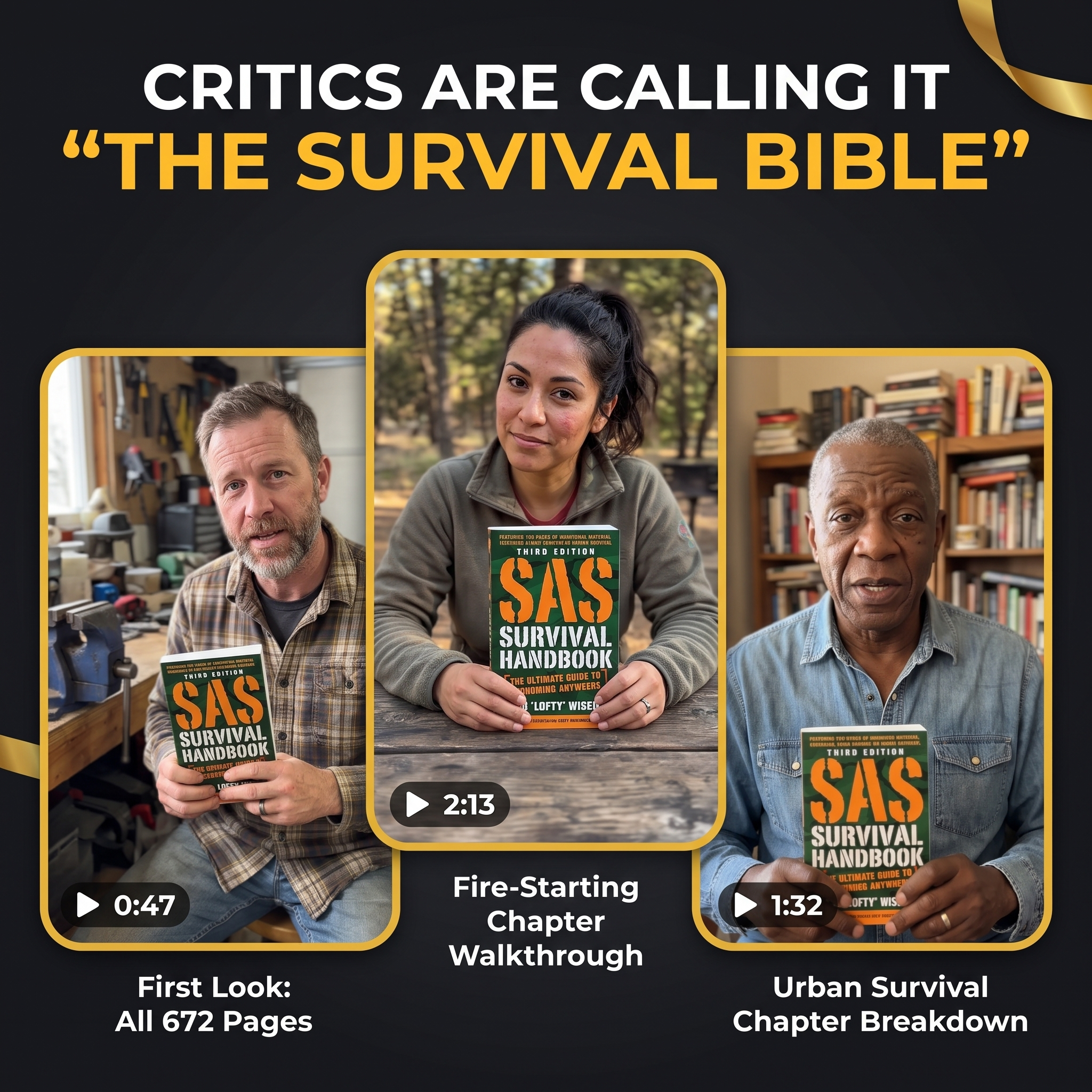
That is the role the SAS Survival Handbook, Third Edition, is built for. Its author, John "Lofty" Wiseman, spent 26 years in the British SAS and ran its survival training. The book covers natural disasters, first aid, water, cold and signalling, along with a full Urban Survival section for the home and the car, all in one volume.
It is one decision, made once. The book goes on a kitchen shelf next to the flashlight and the lantern, and it stays there between storms. When the power goes out again, the questions from night two already have a place in the house where they can be answered, by anyone who can read a page by lantern light.
Always within reach
“I always smile when I find this book lying around the house”
04 · The Next Outage
Run the same outage again, this time with a set of priorities on paper. In the first hour, the focus stays on the basics: everyone accounted for, injuries checked, and warmth and safe light sorted before anything else gets attention. Nobody has to search for what comes next.
By the end of the first day, attention moves to water, food and keeping the house warm without adding risk. By day three, routines are in place for who checks on whom, how drinking water is stored and how the generator is run safely outside. Each step follows from the one before it.
Compare that with night two from earlier. The same questions about water, cold, generators and cuts now have answers on a page within reach. The storm outside is no different. What has changed is that the family knows what to do next, in order, without needing a signal to find out or a neighbor to ask.
Fear replaced by a plan
“Knowledge dispels fear.”
05 · The First 72 Hours
Climate Central, which continued the billion-dollar disaster database after NOAA retired it in 2025, counted 23 billion-dollar disasters in the US in 2025. That is about one every 10 days, compared with one every 82 days in the 1980s. Another 12 were recorded in the first half of 2026.
Response capacity is changing at the same time. A GAO report published in August 2026 found that more than 4,300 employees left FEMA in fiscal year 2025. With disasters arriving more often, help may take longer to reach any single neighborhood in the first days.
The practical conclusion is to plan for the first 72 hours on your own. That means supplies, which most homes already have, and knowledge, which is the part most often missing. A printed handbook on the shelf covers the knowledge, so the next outage can go differently from the last one, even if the storm is just as bad.
Acted the next day
“Got this book on the very next day my government declared a… quarantine”
For the first 72 hours
Disaster, first aid and home-emergency guidance from the man who ran SAS survival training.


4.8 Stars · 8,341 Amazon Ratings
Get the Handbook →
SAS Survival Handbook